
卷积神经网络与计算机视觉核心原理解析
Core Principles of Convolutional Neural Networks and Computer Vision
计算机视觉旨在赋予计算机感知和理解物理世界的能力,即通过观察识别物体及其位置。视觉不仅涉及对静态元素的识别,还包括对动态变化和时间规划的感知,例如在复杂场景中推断物体的运动状态并理解场景的全局特征。
Computer vision aims to equip computers with the ability to perceive and understand the physical world, specifically by identifying objects and their locations through observation. Vision involves not only the recognition of static elements but also the perception of dynamic changes and temporal planning, such as inferring the movement states of objects and understanding the holistic features of a scene in complex environments.
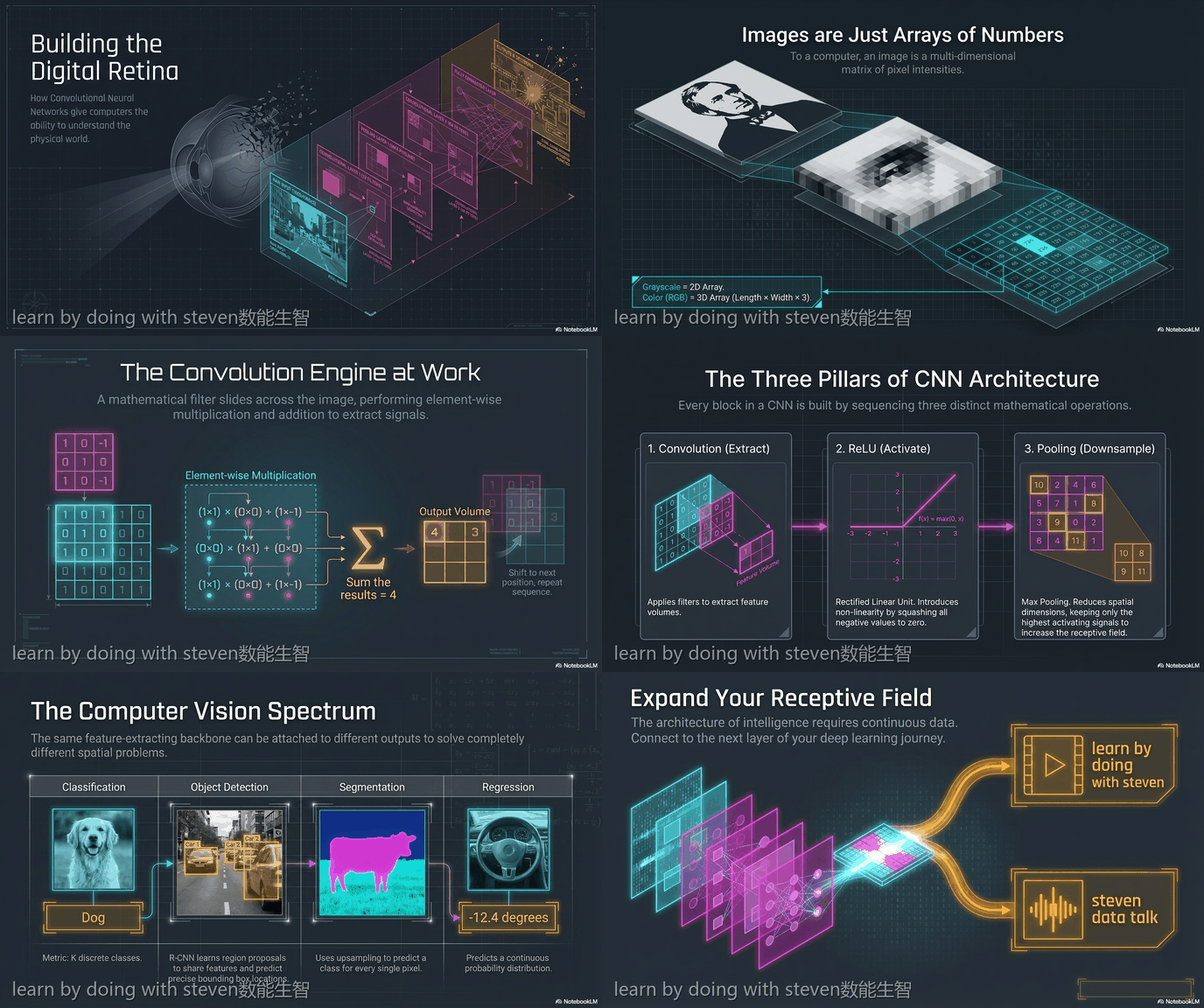
深度学习正在推动计算机视觉算法及其应用领域的巨大变革,其技术已广泛应用于机器人操控、医疗健康检查、自动驾驶汽车以及面部特征检测等领域。对于计算机而言,图像本质上是数字矩阵,其中灰度图像被表示为二维的像素值数组,而彩色图像则由包含红绿蓝色彩通道的三维数组构成。
Deep learning is driving a massive revolution in computer vision algorithms and their application domains, with its technology being widely applied in areas such as robotics manipulation, healthcare screening, autonomous vehicles, and facial feature detection. For a computer, images are essentially matrices of numbers, where grayscale images are represented as two-dimensional arrays of pixel values, while color images consist of three-dimensional arrays containing red, green, and blue color channels.
计算机视觉模型通常处理回归与分类两类任务,回归任务输出连续值,分类任务输出离散的类别标签。为了正确对图像进行分类,系统必须提取不同类别的独特特征;相比于传统机器学习中依赖人工定义特征的局限性,深度学习允许神经网络直接从大量图像数据中自主学习并提取这些复杂的层次化特征。
Computer vision models typically handle two types of tasks, regression and classification, where regression tasks output continuous values, and classification tasks output discrete class labels. To correctly classify images, the system must extract the unique features of different categories; compared to the limitations of relying on manually defined features in traditional machine learning, deep learning allows neural networks to autonomously learn and extract these complex hierarchical features directly from massive amounts of image data.
全连接神经网络在处理图像数据时存在明显缺陷,将二维图像展平为一维输入不仅会完全丢失极其重要的空间排列信息,还会导致模型参数过度膨胀。为了解决这一问题并充分利用图像的局部空间结构,卷积操作应运而生,它通过让输出神经元仅与输入像素的局部图块相连,成功保留了数据的二维空间属性。
Fully connected neural networks exhibit obvious flaws when handling image data, as flattening a two-dimensional image into a one-dimensional input not only completely loses the highly important spatial arrangement information but also leads to an excessive expansion of model parameters. To solve this problem and fully utilize the local spatial structure of images, the convolution operation emerged, successfully preserving the two-dimensional spatial attributes of the data by having output neurons connect only to local patches of input pixels.
卷积神经网络的三个核心操作包括卷积、非线性激活和池化。卷积层通过滤波器在图像上滑动并进行逐元素乘法和加法运算来提取空间特征,非线性激活函数增强了模型的表达复杂性,而池化层则通过下采样有效缩小特征维度并扩大网络在后续处理中的感受野。
The three core operations of a convolutional neural network include convolution, non-linear activation, and pooling. The convolutional layer extracts spatial features by sliding filters across the image and performing element-wise multiplication and addition operations, the non-linear activation function enhances the expressive complexity of the model, and the pooling layer effectively reduces feature dimensionality and expands the network’s receptive field in subsequent processing through down-sampling.
卷积神经网络的架构设计展现出极强的通用性,其特征提取部分可以与不同的输出模块结合以适应多种任务。除了基础的图像分类外,该架构还可延伸至预测物体边界框和类别的目标检测、针对每个像素进行逐一分类的语义分割,以及直接从原始视觉感知和地图数据中回归出连续控制指令的自动驾驶模型。
The architectural design of convolutional neural networks demonstrates extremely strong universality, as its feature extraction component can be combined with different output modules to adapt to various tasks. In addition to basic image classification, this architecture can also be extended to object detection that predicts object bounding boxes and classes, semantic segmentation that performs pixel-by-pixel classification, and autonomous driving models that directly regress continuous control commands from raw visual perception and map data.
感谢您阅读本期节目的完整内容,我们诚邀您关注Learn By Doing With Steven 数能生智频道,收听steven data talk或steven数据漫谈播客。我们在小红书、微信公众号、YouTube、Spotify等各大平台均有布局,欢迎通过节目描述或shownote区域的linktree链接访问我们的所有社媒平台。
Thank you for reading the complete content of this episode, and we sincerely invite you to follow the Learn By Doing With Steven channel and listen to the steven data talk podcast. We have a presence on major platforms including Xiaohongshu, WeChat Official Account, YouTube, and Spotify, and you are welcome to access all our social media platforms through the linktree link in the program description or shownote area.
https://linktr.ee/learnbydoingwithsteven
#计算机视觉 #深度学习 #卷积神经网络 #人工智能 #自动驾驶 #机器学习


